


Introduction
Have you ever taken a step and felt a tiny stone, marble, or folded sock under the front of your foot? It may begin as a slight itch while you are walking or running, and progress to a burning pain that makes you desire to stop and remove your shoe.
If you have a certain familiarity with it, you might have a condition known as Morton’s neuroma.
The pain in the ball of the foot, often between the third and fourth toes, is one of the most obvious signs. Others may also have numbness or tingling, or pain that can radiate into the adjacent toes. These symptoms may become more apparent when exercising or with repetitive pressure on the forefoot.
However, not all forefoot pain is due to Morton’s neuroma. There are other conditions that can cause similar symptoms, including stress injuries, joint problems, footwear problems, nerve irritation, and more. Understanding the different foot and ankle conditions and available treatment options can help you know what to look for when seeking care.
What Exactly Is Morton’s Neuroma?
Morton’s neuroma is a condition that results in pain involving a nerve located in the forefoot. Although the term ‘neuroma’ is used, it is not usually thought to be a cancerous tumour. More typically, it is a nerve irritation and enlargement of tissues around a nerve, typically between the third and fourth toes.
This can occur if the nerve is continually compressed or irritated. Certain activities may increase symptoms, such as activities that apply a lot of stress to the ball of the foot, and tight or narrow shoes may exacerbate symptoms.
This is why pain between the third and fourth toes is an important symptom to pay attention to.
The pain can start slowly. You may not feel it until after a long walk, exercise, or jog. However, symptoms may become more easily provoked over time.
Morton’s neuroma can cause a combination of pain and nerve-related sensations. These can involve a burning, stabbing, or shooting pain, and/or tingling and numbness in the surrounding toes. Others say that they feel like they have a stone in their shoe.
Fortunately, surgery isn’t always the treatment. Conservative options are initially attempted, like changing shoes and decreasing aggravating tasks. If symptoms do not go away, other treatments may be considered.
Common Symptoms: “Does This Sound Like You?”
It’s sometimes hard to diagnose Morton’s neuroma symptoms because other foot conditions can cause similar pain.
A common complaint is that of burning pain in the ball of the foot. It can be sharp, stabbing, shooting, or burning and is usually felt near the space between two toes, typically the third and fourth.
Some of the symptoms people report are:
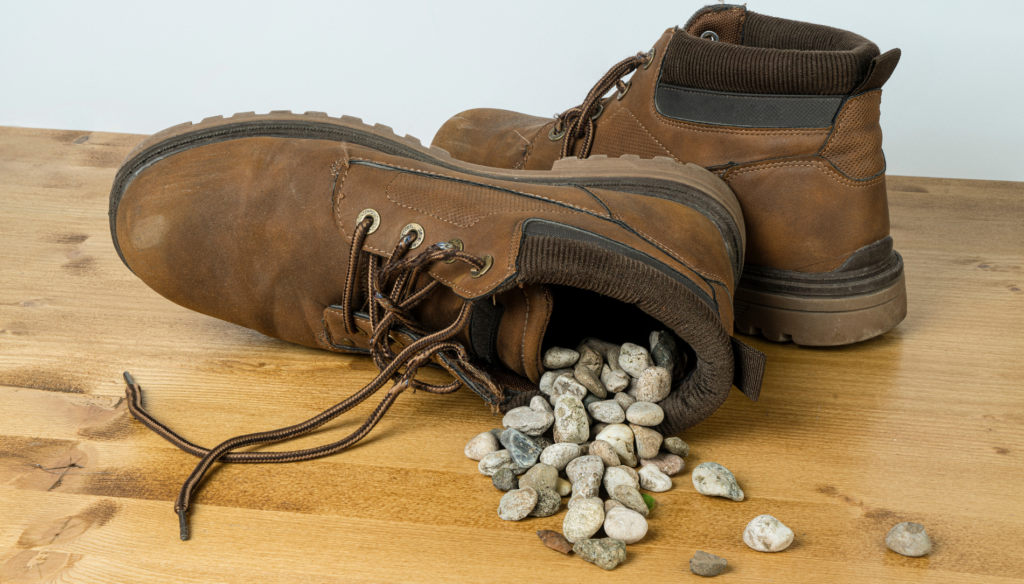
1. Feeling like there is a “pebble in your shoe”
It can be quite particular in its sense. You may need to repeatedly check your shoe, as it feels as though a small stone or marble is under your foot.
One of the sensations of Morton’s neuroma is pain like a pebble in a shoe.
2. Forefoot pain or burning when walking or running.
A stabbing, burning, or shooting pain in the front of your foot may occur. It may be worsened by walking, running, or wearing shoes that put pressure on the forefoot.
3. A feeling of pins and needles in the toes.
The tingling sensation in the toes can occur during walking, especially when the forefoot is placed on the ground repeatedly.

4. Numbness during exercise
If you notice numbness in your toes while running, especially in the toes next to the affected area, don’t automatically assume it’s simply your shoes or training.

5. Pain moving towards toes.
It doesn’t have to be in just one small area. If the problem is in the foot, the pain may spread into the adjacent toes, as the nerve that is affected is also responsible for the sensation in the adjacent toes.
Symptoms may be relieved by halting the activity, resting, or removing shoes. But if there are recurrent symptoms, they should not be ignored again and again; a podiatric evaluation can help determine which foot and ankle treatment options may be appropriate.
What Causes It?
Morton’s neuroma can occur for a variety of reasons, which are often unclear. But pressure or irritation on the nerve more than once is an important factor. Symptoms may be caused by activities and/or footwear that aggravate pressure on the forefoot.
One of the possible causes is shoes that compress the toes/forefoot. High heels may also put pressure on the front of the foot, exacerbating symptoms.
Physical exercise could be a factor, too, for some. High-impact activities like running, jumping, and dancing repetitively overload the forefoot.
This isn’t a rule that exercise is necessarily detrimental to one’s feet. Instead, repetitive loading will cause an already inflamed area to get worse.
But when it comes to finding out the reasons behind sharp forefoot pain, don’t automatically assume that it’s all because of Morton’s neuroma. Forefoot pain can result from other issues such as bone, joint, soft-tissue, or other nerve problems.
Therefore, any symptoms that have persisted or are inexplicable should be evaluated and not self-diagnosed.
Why You Shouldn't Just “Wait It Out”

When the pain in your feet only happens while you are exercising, and then goes away, it’s easy to dismiss it.
It may seem like it’s only been a week, so you might be tempted to wait one more week.
Then one week is another month.
If you repeatedly experience burning pain in the ball of your foot, pain between the toes, or numbness and tingling during activity, it’s worth finding out what’s causing it.
Podiatrists say if foot pain persists, despite changing shoes or cutting back on activities that cause pain, it’s time to see a professional for evaluation.
If symptoms remain, everyday activities can become increasingly frustrating as well. Walking, exercising, working, or even wearing a favorite pair of shoes may become uncomfortable.
The goal isn’t to assume you have Morton’s neuroma. The goal is to identify the actual source of your pain so you can choose an appropriate treatment plan.
Early evaluation can also help distinguish Morton’s neuroma from other potential causes of forefoot pain.
How Is It Diagnosed?
The diagnosis of Morton’s neuroma typically starts with a medical history and physical exam.
A health care professional may question you about the location of the pain, how it feels, what activities cause the pain, the type of shoes you wear, and whether the pain causes tingling or numbness.
They can press on various parts of the forefoot to check for any tenderness during the examination. They may also squeeze the forefoot and feel for any “clicking” between the metatarsal bones. Other issues concerning the function of the toes and/or other parts of the foot can also be assessed.
X-rays and MRIs are not always required to diagnose Morton’s neuroma, but they might be used if the diagnosis is not clear or if another condition must be ruled out.
X-ray, ultrasound, or MRI may be suggested depending on the circumstances. For instance, an X-ray may be used to help diagnose some bone issues, and ultrasound or MRI may be used to obtain soft tissue information.

Treatment Options
The good news is that it’s possible to treat Morton’s neuroma without immediate surgery.
The treatment varies based on the severity of symptoms, length of symptoms, and how symptoms interfere with your activities.
First, change shoes.
A great place to begin is with your shoes.
Shoes that have a wide toe box can provide the forefoot with more space and decrease the crowding. Low-heeled shoes might also decrease the pressure compared to high heels. Further support and cushioning can be achieved through inserts/pads.
Also, if the symptoms are connected to running or another high-impact activity, then reducing activities that cause pain temporarily could prove beneficial as well.
Consider supportive inserts

An insert or forefoot pad in the shoes may be useful to spread the weight away from the painful area.
Whether an over-the-counter or custom shoe insert is appropriate will depend on your foot type and symptoms, and a podiatrist can help decide which would be best for you.
Symptom management & ice.
Ice massage can be used to relieve pain in some people. Some people may also find that nonprescription anti-inflammatory medicines can help alleviate pain, but they are not suitable for everyone.
When deciding on medication, consult your healthcare professional or pharmacist to know if it’s safe for you.
An injection could be an alternative treatment.
If conservative treatment isn’t enough, a healthcare professional may consider a corticosteroid injection around the affected nerve.
Surgery isn't usually the first step.
If other treatments have failed to relieve symptoms, then surgery might be an option.
A surgical procedure called a neurectomy can be used to remove the damaged, enlarged nerve. Surgery is successful, but may result in permanent numbness in the affected toes.
What’s key is that the treatment should be customized. It is not automatically a sign of Fore Foot Pain that surgery will be required.
Why See a Podiatrist Specifically?

Podiatrists are doctors who specialize in the diseases and injuries of the feet and ankles.
This may help when you have a mix of symptoms such as pain, tingling, burning, or numbness. A podiatrist can examine your foot type, shoes, activity, and where your pain is occurring, rather than just treating your pain.
For instance, if you are experiencing numbness in your toes when running, the doctor can determine if the numbness is consistent with Morton’s neuroma or could be due to another condition.
Similarly, if pain between the third and fourth toes is your main concern, targeted foot exams may find out if nerve issues are at fault.
A podiatrist can also review conservative measures like sock and shoe modifications, supportive devices, and see if there are other tests or treatments that are needed or appropriate.
The secret is to make the right diagnosis and then select the right treatment.
Reading experiences from other patients can also give you a better understanding of what to expect when visiting a foot and ankle specialist.
How to Know If It's Time to See a Specialist
You should consider seeing a specialist if you experience:
- Recurring pain in the ball of your foot
- Burning, stabbing, or shooting pain between the toes
- Tingling or numbness in the toes
- A repeated “pebble” or “marble” sensation inside your shoe
- Pain that worsens with walking, running, or other activities
- Symptoms that continue despite changing footwear or reducing aggravating activities
- Forefoot pain that is becoming more frequent or interfering with everyday activities
A foot and ankle specialist can examine the location and pattern of your pain, assess your footwear and activity habits, and determine whether your symptoms are consistent with Morton’s neuroma or another cause of forefoot pain. Imaging such as X-rays, ultrasound, or MRI may be considered when needed to evaluate other possible conditions and guide appropriate treatment.
FAQs About Morton’s Neuroma
It may feel like sharp, stabbing, shooting, or burning pain in the ball of the foot. Some people describe it as feeling like a marble or pebble is inside their shoe. Tingling or numbness in nearby toes can also occur.
It can be. Morton’s neuroma commonly affects the nerve between the third and fourth toes, so pain in this area is a recognized symptom. However, other conditions can cause similar pain, so location alone cannot confirm the diagnosis.
Yes. Numbness or tingling can occur in the toes supplied by the affected nerve.
Running can aggravate symptoms because it repeatedly places pressure on the forefoot. If running consistently triggers pain, burning, tingling, or numbness, reducing aggravating activity and seeking professional advice may be appropriate.
Tight or narrow footwear and high heels can increase pressure on the forefoot and may worsen symptoms. Wider, lower-heeled shoes are commonly recommended as part of initial management.
Conclusion
It’s annoying to have pain in the ball of your foot, particularly if it’s affecting the things you like to do. A pebble-like or burning sensation in the ball of the foot, tingling in toes during walking, or numbness in toes during running could be a sign of Morton’s neuroma, but it is not the only sign.
The type of your symptoms is important. So do the location of the pain, the activities that seem to cause it, the shoes you wear, and whether you find relief from the pain with rest.
Avoid weeks of wondering what is causing pain in the anterior part of the foot.
Your podiatrist will be able to examine your foot, brainstorm the various possible causes, and help you determine if your symptoms are consistent with Morton’s neuroma or another condition. You can also read what other patients have shared about their experiences with foot and ankle care.
If your foot pain is recurring, worsening, or interfering with your daily activities, then it may be time to see a qualified podiatrist for an evaluation.
The information provided in this article is for general educational purposes only and should not replace individual medical advice, diagnosis, or treatment.